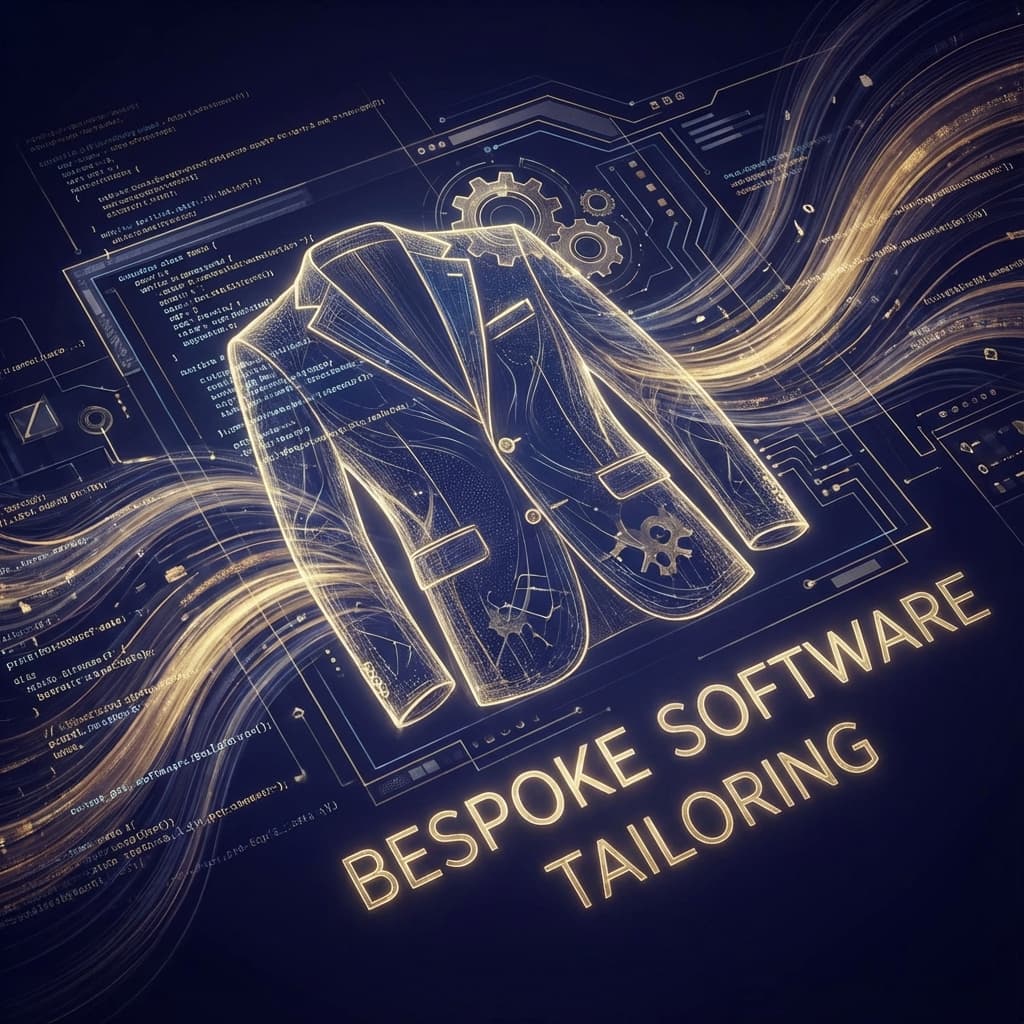
The "Bespoke Suit" Analogy: Why Software Must Fit
Choosing the right software for your company is surprisingly similar to buying a suit. You effectively have two options, and each serves a completely different purpose.
You can buy a suit off the rack. It's fast, affordable, and works fine for many people and occasions. However, the fit is rarely perfect—the sleeves might be a bit too long, or the shoulders might pinch. This is off-the-shelf software (or SaaS). It provides a ready-made solution that gets the job done for standard needs, but it often forces you to adapt your unique business processes to the standardized design of the tool.
The alternative is a bespoke suit. A tailor takes your exact measurements and creates something that fits you perfectly, in a style unique to you. It's a larger investment of time and money, but the result is a perfect fit that enhances your presence and confidence. This is custom software. It is designed and built 'from scratch' to seamlessly align with your company's exact operational needs. It gives you a powerful, unique tool that no one else has.
In this guide, we dive deep into these two approaches. We dissect the differences, the financial reality, and help you decide which strategy fits your ambitions for 2026. See also our Custom App Development approach for more context.
1. The Two Main Flavors: SaaS vs. Bespoke
Let's sharpen the definitions first.
What is Off-the-Shelf Software (SaaS)?
Also called 'pre-packaged' software. These are generic applications designed for the masses. Think Microsoft 365, Salesforce, or Slack. They are built to be "good enough" for as many different companies as possible. You rent the license, but you own nothing.
What is Custom Software (Bespoke)?
Also called 'tailor-made' software. This is an application designed, developed, and built specifically for one company. Instead of your team adapting to the software's rules, the software adapts to your team's unique workflow. It is a one-of-a-kind tool that is fully your property.
2. The SaaS Illusion: 5 Surprising Truths About Cost and Value
Conventional wisdom says SaaS is always the cheaper, smarter option due to low entry costs. But this view often ignores the Total Cost of Ownership (TCO) and long-term strategic value. Here are five counter-intuitive insights every leader should know.
Truth #1: The Subscription Trap
While custom software requires a higher initial investment, the recurring subscription costs of SaaS—which often rise as you add more users—can explode over the long term.
A five-year analysis often paints a different picture:
- Total SaaS subscription spend over five years is typically 72% higher than the initial build cost of custom software.
- Companies with custom solutions report an average 55% ROI over five years, compared to just 42% for SaaS implementations.
Truth #2: Utility vs. Asset
The fundamental difference is financial. A SaaS subscription is an operational expense (OpEx)—you are renting a tool from a vendor. Custom software is a capital asset (CapEx) that is fully your property.
This is crucial. Owning a software asset increases your company's book value and makes you more attractive to investors or in an exit scenario. You own the code, the IP, and the roadmap. You are no longer a tenant, but an owner.
Truth #3: Your "Workarounds" Are a Red Flag
How do you know if you've outgrown your current software? Look at your team's frustrations.
- Excel Hell: If teams have to maintain complex spreadsheets alongside your "main software", that is a sign of failure.
- Double Entry: Manually retyping data from one system to another is a waste of human capital.
- Process Dilution: If you have to water down your unique workflow because "the system can't do that", you are losing your competitive edge.
Truth #4: It's Not "All or Nothing"
Choosing custom doesn't mean you have to tear everything down and rebuild. Legacy Modernization is a powerful middle ground. Here, you strategically transform outdated systems into modern architectures (like cloud-native microservices) without disrupting core processes. It is evolution, not revolution.
Truth #5: Custom Can Be More Secure
It sounds contradictory: don't big SaaS giants have better security? Often yes, but they are also a much larger target. Custom software benefits from "security by design", tailored to your specific risk profile and compliance requirements (such as in healthcare or finance). Moreover, you are not part of a massive database that hackers are trying to crack. Data shows that after a breach, 68% of custom software users could fully recover their data, versus 52% of SaaS users.
3. A Look Inside the Kitchen: Full-Stack Development
When you choose custom, you choose craftsmanship. Just as a top restaurant runs on a chef (back-end) and the service/presentation (front-end), modern software runs on Full-Stack Development.
This is the technical engine behind your asset. A full-stack developer (or team) masters the entire spectrum:
- The Front-End (What the user sees): The interface, the experience, the "look and feel". Built with technologies like React.js or Vue.js for that smooth, app-like experience.
- The Back-End (The engine): The logic, the database, the server. Often built with Node.js or Python to process data securely and make smart calculations.
The advantage of this holistic approach is speed and cohesion. Because one team oversees the entire picture, business logic and user experience align seamlessly. There is no "loss in translation" between the database administrator and the web designer.
Conclusion: Choosing Strategically
Back to the suit. An off-the-rack suit isn't "bad". For standard functions like email or accounting (Microsoft 365, Xero), SaaS is absolutely the smartest choice. Reinventing the wheel is a waste of time.
But when your unique process is your "secret sauce"—the reason why customers choose you and not the competitor—then cramming that process into a standard SaaS box is a strategic error.
At that moment, custom software is no longer a cost center, but a weapon. It is the choice to stop renting and start building your own future.
Wondering if your situation calls for a bespoke suit? Look at your friction. Where does your current software feel like a jacket that's just too tight? That is where your opportunity for growth lies.